Ask any dental receptionist or office manager how long they spend verifying insurance, and they’ll tell you it’s one of the most frustrating bottlenecks in their day.
Manual verification takes between 15 and 45 minutes per patient. Multiplied across a standard schedule, your front desk loses hours of productive time every day to administrative overhead.
So why does a routine check eat up so much of the day, and how are some practices getting that number down to almost nothing?
Below, we break down where the time actually goes, what it costs your clinic, and the realistic way to take most of the work off your team’s plate.
(For the full picture, see our complete guide to dental insurance verification in Canada.)
Typical Dental Insurance Verification Timeframes in Canada
How much time verification consumes depends entirely on the workflow your practice employs. Here is a realistic breakdown of the different approaches:
- Calling the Insurer (15 to 45 minutes per patient): This is the most resource-heavy method. Your staff is forced to navigate complex phone trees, sit on hold, and manually transcribe plan details.
- Checking Carrier Portals (10 to 20 minutes per patient): Logging into various carrier websites is faster than calling, but it is still a repetitive, one-patient-at-a-time task. Additionally, online portals often provide incomplete summaries, forcing a follow-up phone call to verify frequency limits or alternate benefit clauses.
- Basic Verification Plug-ins (5 to 15 minutes per patient): Some tools retrieve basic summaries but still require manual data entry, manual cross-referencing, and final transcription into your practice management software.
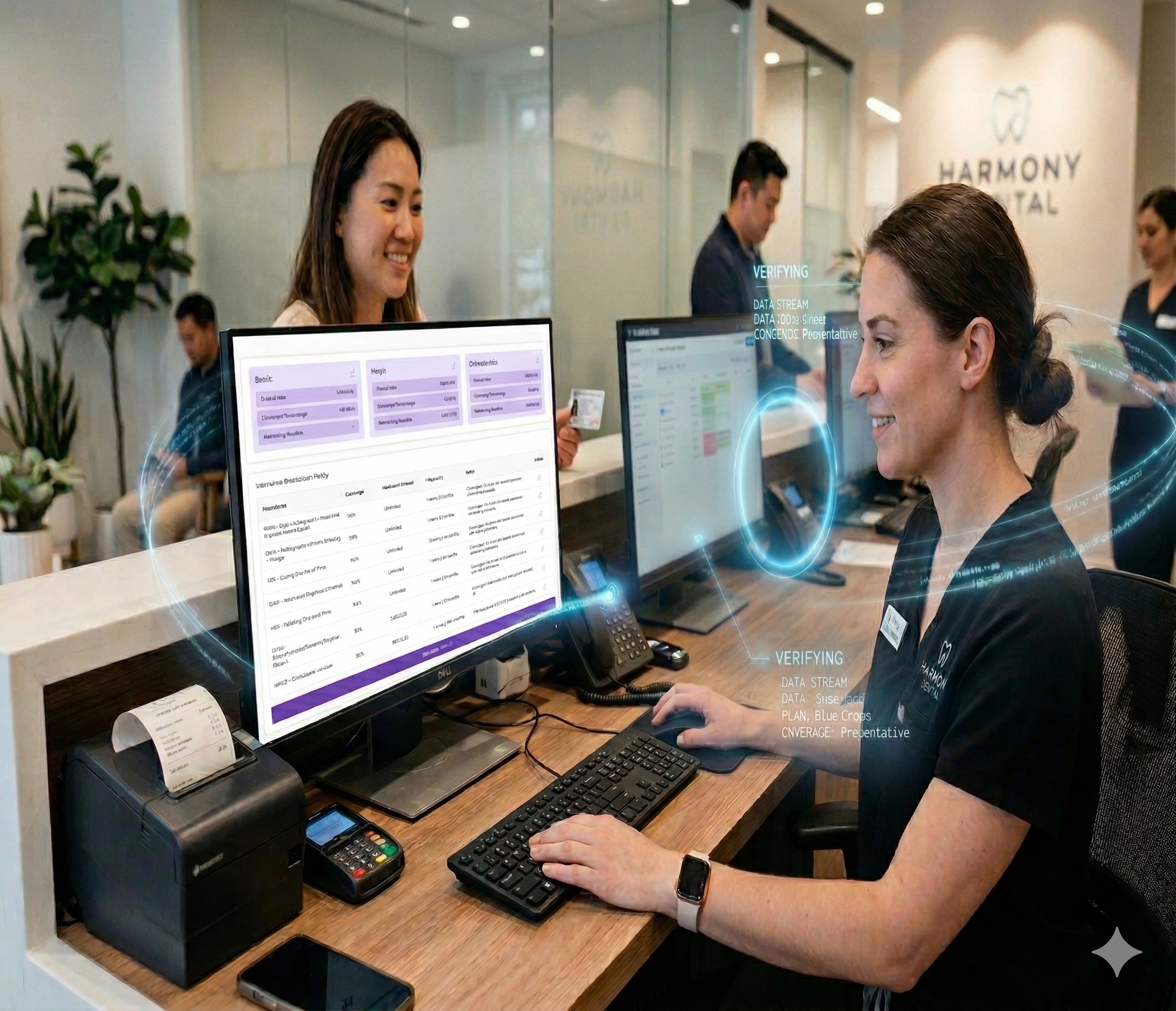
- Fully Automated, Integrated Systems (Essentially zero staff time): AI-powered platforms like Smilepass run checks automatically in the background prior to patients’ appointments. Breakdowns are pushed directly into patient charts in your PMS (like Dentrix, Abeldent, Cleardent or any other supported system) before the patient arrives.
Why Dental Insurance Verification Takes So Long
If you have ever monitored front-office operations, you know that insurance verification is unpredictable. A few key factors frequently slow the process down:
- Peak Hold Times: Insurer call centers spike in call volume during lunch hours, at the end of the month, and in January when policy maximums reset.
- Plan and Code Complexity: Basic cleanings are easy to check, but complex procedures (like crowns, bridges, or periodontal scaling) require looking up specific clauses and alternate benefits (such as molars being downgraded to amalgam rates).
- Coordination of Benefits (COB): Verifying secondary insurance and calculating exact co-payments and coordination rules routinely doubles verification time.
- Administrative Learning Curve: The learning curve for Canadian insurance rules is steep. A junior receptionist might take 45 minutes on a verification that a senior office manager can complete in 15.
- Last-Minute Scheduling: Same-day emergencies or filling last-minute openings from a cancellation list under pressure are difficult to verify manually. If details aren’t verified timely, the practice takes on billing risks.
The Hidden Costs of Slow Insurance Verification
Administrative delays have a direct, negative impact on clinical and financial performance:
- Reduced Treatment Acceptance: Patients hesitate when faced with financial ambiguity. If your team cannot provide a definitive out-of-pocket estimate, the patient is far more likely to delay restorative or elective treatment.
- Billing Disputes and Write-offs: Rushed verifications lead to missed details. When a claim is processed and the coverage is less than estimated, your office is stuck in the uncomfortable position of billing the patient for the difference or writing off the loss.
- Underutilized Chair Time: If your team cannot verify coverage for an emergency walk-in or a last-minute cancellation, the chair stays empty, directly lowering your daily production.
- Front-Desk Turnover: Chasing insurance is a primary cause of office staff fatigue. Reducing administrative burden improves employee retention and allows your team to focus on high-value patient coordination.
How to Make Dental Insurance Verification Instant
The way out of these bottlenecks is to stop doing every lookup manually. The catch is that an automated tool only helps if it does three things well:
- Integrate directly with your practice management software.
- Cover the full range of Canadian carriers.
- Run on its own before the appointment.
That’s the standard we built Smilepass to. It was founded by dentists who spent years dealing with these administrative headaches, so it’s shaped around how a dental office actually runs:
- Proactive Verifications: Checks are completed automatically ahead of the appointment. Your team starts the day with accurate insurance details already prepared.
- Direct PMS Syncing: Pushes breakdowns directly into your practice management software (like Dentrix, Abeldent, Cleardent or any other supported system) without manual transcription.
- Universal Canadian Coverage: Supports national carriers (such as Sun Life, Manulife, Green Shield, and more), regional Blue Cross offices, TPAs, and public programs like the CDCP and NIHB.
- Granular Data Extraction: Captures complex plan rules, including frequency limits, maximums, coverage percentages, and predetermination requirements to ensure your treatment estimates are highly accurate.
The Bottom Line
Automating your dental insurance verification workflow reduces administrative time to near zero, improves estimate accuracy, and keeps your front desk happy.
Book a Smilepass demo today to see it in action.
Take the pain out of insurance verification with Smilepass
Frequently Asked Questions
How long does manual verification take in Canada?
For a straightforward plan, it usually takes 15–20 minutes via portal or phone. For complex plans, coordination of benefits, or during peak hours, it can easily take 30–45 minutes.
Can walk-in or emergency patients be verified quickly?
Yes. While manual verification for a walk-in is stressful, Smilepass allows you to run an on-demand verification that returns a complete breakdown in minutes.
Why are some insurers harder to verify than others?
Some carriers have limited portal data or long hold times on their phone lines. Automated tools help bypass these bottlenecks by pulling the required data directly and systematically.
Does automating verification require changing our practice management system?
No. Smilepass is designed to integrate with major Canadian practice management systems, so it works alongside the software your team is already using.