For most dental practices in Canada, insurance verification is the work that nobody notices until it goes wrong. It’s detail-heavy, easy to get wrong, and the fallout lands everywhere that counts: denied claims, surprised patients, write-offs, and a front desk buried in paperwork.
In this guide, we’ll walk through how dental insurance verification works in Canada, the challenges of doing it manually, and why more practices are transitioning to automated, AI dental insurance verification to keep their schedules running smoothly.
What Is Dental Insurance Verification?
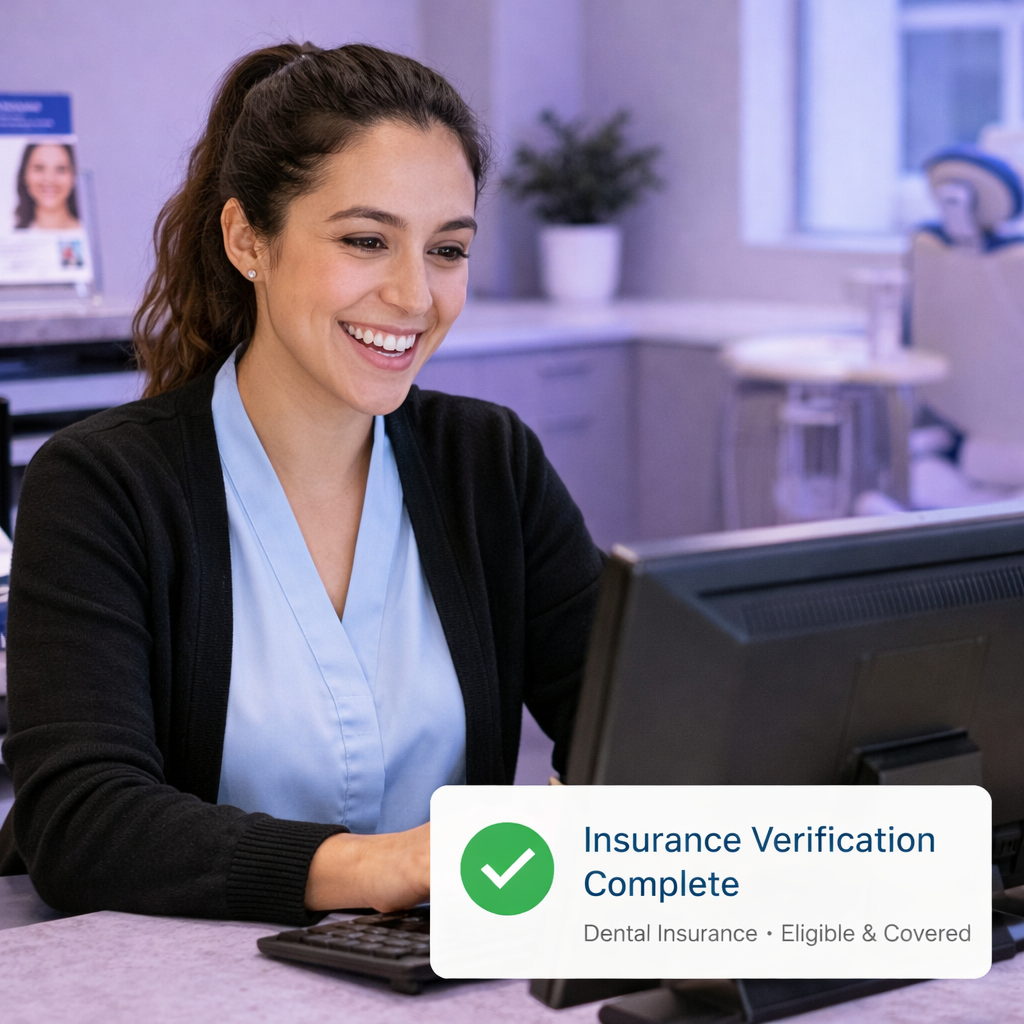
To start, let’s define dental insurance verification. Simply put; it is the process of confirming a patient’s active coverage and plan details before they receive treatment.
Before your treatment coordinator or front desk can put together an accurate estimate, they need to know:
- Active Status: Is the policy active on the exact date of service?
- Remaining Balances: What is the patient’s remaining annual maximum?
- Category Breakdowns: What are the exact coverage percentages for diagnostic, preventive, basic, major, and orthodontic categories?
- Frequency Limits: Are there strict limits (e.g., recall exams every 6 vs. 9 months, or polishing limits)?
- Exclusions and Restrictions: Do they have a missing tooth clause, waiting periods, or specific material downgrades (like composite to amalgam on molars)?
- Billing Terms: Does the plan support assignment of benefits, or is the patient responsible for payment upfront?
- Coordination of Benefits (COB): How does coverage align if they have secondary insurance?
Having this level of detail is the difference between a confident treatment presentation and a billing dispute. Cost is the biggest reason Canadians delay dental care: Statistics Canada found that 24% of Canadians aged 12 and older avoided an oral health professional because of cost in 2023/2024, climbing to 45% among those without insurance.
When patients know exactly what their plan covers, and what they’ll owe out of pocket, you remove that uncertainty at the moment it matters most, and make it far easier for them to say yes to treatment.
Why Dental Insurance Verification Matters Now More Than Ever
The Canadian dental landscape is shifting rapidly, making accurate benefits verification a core business requirement:
- The Canadian Dental Care Plan (CDCP): This federal program introduced millions of newly covered patients to clinics. Many have never had dental benefits before and rely heavily on your team to explain how their plan works. (See our CDCP dental verification guide for the full workflow.)
- Customized Employer Plans: Employers are opting for highly customized group benefits to manage costs. You can no longer safely assume that two patients working for different companies under the same carrier (e.g., Sun Life or Manulife) have the same coverage.
- The Demand for Financial Transparency: Patients expect clear, upfront pricing. Patients are more conscious of costs and want to know their exact out-of-pocket portion before they sit in the operatory, not weeks later when a claim or predetermination comes back.
The Traditional Dental Insurance Verification Process in Canada
In most Canadian practices, the standard verification workflow looks like this:
- Intake: The patient books an appointment and provides their policy and certificate numbers.
- The Chase: An admin team member logs into multiple insurance portals or calls the carrier to request a breakdown.
- Data Entry: The staff member transcribes these coverage details into your practice management software (PMS) like Cleardent, Tracker, Dentrix, or AbelDent.
- Clinical Review: The treatment coordinator or hygienist reviews the breakdown before the patient’s appointment.
- Presentation: You generate a treatment plan and patient estimate based on that breakdown.
While this sounds straightforward, it actually takes 10 to 45 minutes per patient. For a clinic seeing 30 to 40 patients a day, your front-desk team spends hours daily simply chasing down data.
That’s time that could be spent filling open chair time, handling recall, or building relationships with patients in the waiting room.
The Hidden Costs of Manual Dental Insurance Verification
Relying on manual verification exposes your clinic to several operational risks:
- Inaccurate Patient Estimates: When admin staff gather breakdowns under pressure, details like frequency limits, material downgrades, or waiting periods are easy to miss. This leads to inaccurate predeterminations and billing surprises.
- Lost Revenue and Write-offs: If a patient is quoted incorrectly and their insurance covers less than expected, the clinic is often forced to write off the difference or chase the patient for an unexpected balance, damaging the relationship.
- Empty Chairs and Cancelled Appointments: Without real-time verification, same-day cancellations or emergency walk-ins can’t be verified quickly. Your team is forced to either guess the coverage or postpone treatment, leaving valuable chair time unused.
- Administrative Burnout and Turnover: Insurance chasing is repetitive, high-stress, and tedious. It’s a primary driver of front-desk turnover in Canadian dental clinics.
- Inconsistent Documentation: Different team members record breakdowns in different ways. This inconsistency leads to confusion between the front desk, the clinical team, and the patient.
The Major Canadian Dental Insurance Companies You’ll Work With
The Canadian dental insurance landscape is highly fragmented (our complete list of Canadian dental insurance companies covers every carrier in detail). To run a smooth office, your team must navigate:
- National Private Insurers: Major carriers like Sun Life, Manulife, Canada Life, Desjardins, Beneva, Empire Life, Equitable Life, iA Financial Group, RBC Insurance, and Co-operators.
- Regional Blue Cross Offices: Independent provincial organizations, including Pacific Blue Cross, Alberta Blue Cross, Saskatchewan Blue Cross, Manitoba Blue Cross, Ontario Blue Cross, Quebec Blue Cross, and Medavie Blue Cross.
- Third-Party Administrators (TPAs): Entities like Green Shield Canada (GSC), ClaimSecure, Cowan, Johnson, People Corporation, GroupHEALTH, NexgenRx, and Maximum Benefit.
- Public Programs: The CDCP (administered by Sun Life), NIHB for First Nations and Inuit (administered by Express Scripts Canada), and provincial social assistance dental programs.
Many software tools only support the top three or four national private insurers, forcing your team to manually verify the rest.
Smilepass was built to integrate the entire Canadian market, handling everything from private insurers to provincial public plans in a single system.
Automated Dental Insurance Verification: The New Standard
More Canadian practices are dealing with this bottleneck by automating insurance verification entirely. Instead of staff working through portals one patient at a time, the checks run quietly in the background before anyone arrives.
A good automated verification system should:
- Run Proactively: Verify eligibility and plan details overnight, so breakdowns are ready before the patient arrives.
- Integrate with Your PMS: Push data directly into your existing software Integrations | Smilepass to eliminate copy-paste errors.
- Provide Universal Coverage: Support all Canadian private insurers, regional Blue Cross offices, TPAs, and public programs.
- Capture Granular Rules: Parse specific frequency limits, material downgrades, and coordinate secondary coverage automatically.
By automating this process, your clinic can reclaim hours of administrative time each week while significantly reducing billing errors.
How Smilepass Delivers More Accurate Dental Insurance Verification Than the Competition
Smilepass was built for the Canadian dental market by dentists who experienced these challenges firsthand. And here’s what sets it apart:
- Direct PMS Integration: Smilepass connects directly with your practice management software, automatically updating patient files with verified insurance details.
- Pre-Appointment Verifications: The system runs checks automatically. Your front desk starts the day with completed, accurate breakdowns already waiting for every scheduled patient.
- Comprehensive Carrier Coverage: Smilepass verifies coverage across all Canadian insurance providers, including private carriers, regional Blue Cross plans, TPAs, and government programs like the CDCP and NIHB.
- High-Precision Details: Smilepass goes beyond basic percentages. Our AI algorithm extracts key details like frequency limitations, predetermination rules, missing tooth clauses, and coordination of benefits to ensure your chairside treatment estimates are highly accurate.
- Experienced Human-in-the-Loop Support: Every clinic gets a dedicated account specialist who knows your practice and all the Canadian insurance carriers. Our human-in-the-loop model means complex cases, unusual plans, and edge-case discrepancies get resolved by an experienced person, not left for your front desk to figure out.
The Bottom Line
Managing dental insurance verification manually doesn’t just eat up valuable admin hours; it also risks billing errors and reduces overall profitability of your practice.
If you’re ready to see how automated dental insurance verification can streamline your practice, book a Smilepass demo today.
Take the pain out of insurance verification with Smilepass
Frequently Asked Questions
Is dental insurance verification mandatory in Canada?
Technically no, but running a practice without it is incredibly risky. Accurate verification is what prevents claim denials, billing disputes, and unexpected write-offs.
Can patients verify their own dental insurance?
Patients can check their member portals, but they rarely know how to find the specific details a clinic needs, like frequency limits or alternate benefit rules. It’s almost always safer for the clinic to confirm these details.
How accurate is automated dental insurance verification?
It depends on the platform. Tools that only pull basic summaries will miss the fine print. Smilepass is built to capture the complete breakdown, including the complex rules that are easy to overlook, making it highly reliable for predetermination estimates.
How long does it take to set up automated dental insurance verification?
Most practices are up and running within a few days. Because Smilepass integrates with major Canadian practice management systems and works with every carrier out of the box, there’s no drawn-out onboarding.